

One in five people with myopia thinks, “I’ll get surgery someday.” But when they actually start looking into it, the options feel overwhelming. LASIK or LASEK? SMILE or standard? What about Ortho-K lenses? In 2026, the technology has become more precise and the choices more varied than ever. Here’s everything you need to know to find the right method for your eyes — all in one place.
근시인구 5명 중 1명은 “언젠가 수술받겠다”고 생각한다. 그런데 막상 알아보면 선택지가 너무 많다. 라식인지, 라섹인지, 스마일라식인지, 드림렌즈인지. 2026년 현재, 기술은 더 정밀해졌고 선택지는 더 다양해졌다. 지금 내 눈에 가장 맞는 방법이 무엇인지, 한 번에 정리해준다.

Option ① Contact Lenses — The Most Flexible Choice
If surgery feels daunting, your myopia is still progressing, or the cost is a barrier, contact lenses remain the most practical choice available.
Soft contact lenses deliver immediate correction the moment you put them in, and their greatest strength is flexibility — you can stop wearing them anytime or change your prescription as needed. The downsides are daily maintenance and the dryness and reduced oxygen supply that come with extended wear. Silicone hydrogel lenses have gone a long way toward addressing these limitations.
Best for:
Adults in their early 20s whose myopia is still progressing, anyone whose corneal condition isn’t suitable for surgery, and those who want to minimize upfront costs.
방법 ① 콘택트렌즈 — 가장 쉽고 유연한 선택
수술이 두렵거나, 아직 근시가 진행 중이거나, 비용 부담이 크다면 콘택트렌즈는 여전히 가장 현실적인 선택이다.
소프트 콘택트렌즈는 착용 즉시 교정 효과를 볼 수 있고, 언제든 착용을 중단하거나 도수를 바꿀 수 있다는 유연성이 최대 장점이다. 단점은 매일 착용·관리가 필요하고, 장시간 착용 시 눈 건조함과 산소 공급 저하가 생길 수 있다는 점이다. 실리콘 하이드로젤 소재 렌즈가 이 단점을 상당 부분 보완해주고 있다.
이런 사람에게 추천
아직 근시가 진행 중인 20대 초반, 수술이 두렵거나 각막 조건이 수술에 적합하지 않은 경우, 비용 부담을 최소화하고 싶은 경우.
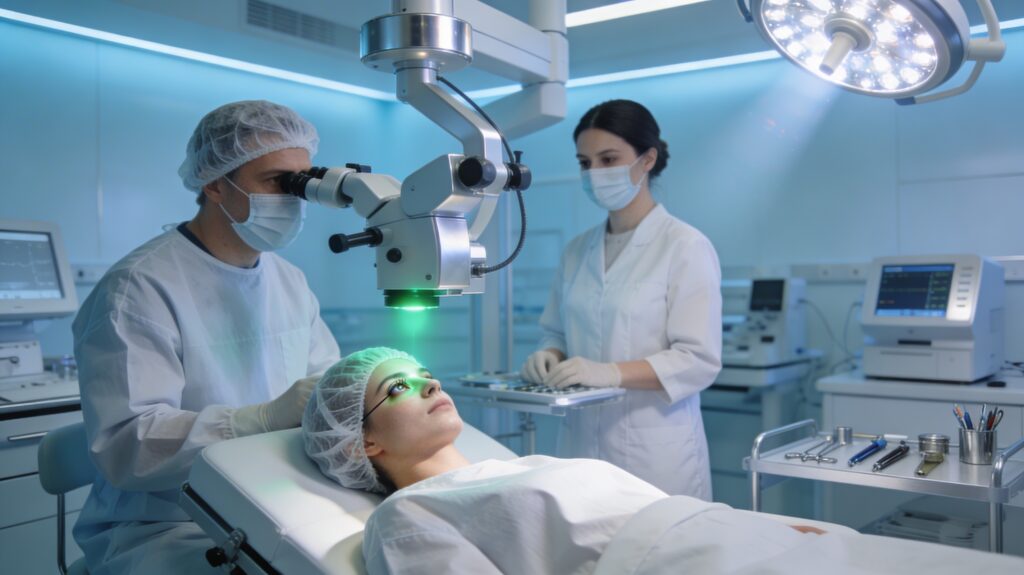
Option ② LASIK / LASEK / SMILE — Permanent Correction, Done Once
These are the three main methods of surgical vision correction. All three work by reshaping the cornea with a laser to adjust its refractive power, but the technique differs — and so do recovery timelines and risk profiles.
LASIK creates a thin corneal flap, applies the laser correction underneath, and repositions the flap. Pain is minimal and most people return to daily life the very next day. The trade-off is that the corneal flap makes the eye relatively more vulnerable to physical impact.
LASEK removes the corneal epithelium directly before laser treatment, without creating a flap. Recovery takes longer than LASIK, but the eye is more resilient to impact afterward — making it a better fit for athletes or people in physically demanding professions.
SMILE (SMILE Pro) is the most advanced method currently available. It requires only a minimal corneal incision, preserves more of the front corneal structure, and carries a lower risk of dry eye than older methods. It is also the most expensive option and is not yet available at every clinic.
2026 average costs in Korea: Custom LASEK approximately 1.3 million KRW, Custom LASIK approximately 1.6 million KRW, SMILE Pro approximately 3.2 million KRW.
Best for:
Adults whose myopia has stabilized (generally 18 and over), those with sufficient corneal thickness, and anyone who wants to be completely free of lens management.
방법 ② 라식·라섹·스마일라식 — 한 번으로 끝내는 영구 교정
수술적 시력 교정의 3대 방법이다. 원리는 모두 레이저로 각막을 깎아 굴절력을 조정하는 것이지만, 방식에 따라 회복 속도와 부작용 프로파일이 다르다.
라식은 각막에 얇은 절편을 만든 후 레이저로 교정하고 다시 덮는 방식이다. 통증이 적고 수술 다음 날부터 일상생활이 가능할 정도로 회복이 빠르다. 다만 각막 절편이 생기기 때문에 외부 충격에 상대적으로 취약하다.
라섹은 각막 절편 없이 상피를 제거한 후 레이저를 조사하는 방식이다. 회복 기간이 라식보다 길지만 외부 충격에 강해 운동선수나 활동적인 직업군에 더 적합하다.
스마일라식(스마일 프로)은 현재 가장 최신 방식으로, 각막을 최소한만 절개해 시력을 교정한다. 전면 각막 조직 구조를 보존하고 안구건조증 발생률이 낮다는 것이 가장 큰 장점이지만, 비용이 가장 높고 모든 병원에서 시행되지 않는다.
2026년 기준 평균 비용은 올레이저 라섹 약 130만 원, 커스텀 라식 약 160만 원, 스마일 프로 약 320만 원 수준이다.
이런 사람에게 추천
근시가 더 이상 진행되지 않는 성인(만 18세 이상 권장), 각막 두께가 충분한 경우, 렌즈 관리의 번거로움에서 완전히 벗어나고 싶은 경우.
Option ③ Ortho-K (Dream Lens) — Correction While You Sleep, No Surgery Required
Ortho-K lenses sit in a unique space between surgery and standard contact lenses. You wear specially designed rigid lenses overnight, which gently reshape the central cornea to temporarily correct its refractive power. Remove them in the morning, and you can see clearly with bare eyes for the entire day.
The most compelling feature is their ability to slow myopia progression in growing children. Research shows that children wearing Ortho-K lenses experience myopia progression at less than half the rate of those wearing glasses alone, with an average suppression of around 34%. This is why they remain consistently popular among parents of school-age children.
The downsides are cost and upkeep. The initial investment runs approximately 1 million KRW or more for both eyes, and the lenses require nightly wear and careful daily cleaning. As rigid lenses, they also carry the risk of loss or breakage. Most importantly, the correction is not permanent — once you stop wearing the lenses, the cornea returns to its original shape and vision reverts accordingly. This is something every user must fully understand before starting.
In recent years, the correctable range has expanded to cover high myopia up to -6.0 diopters, and custom-fitted lens technology tailored to individual corneal topography has advanced significantly.
Best for:
Children and teenagers with progressing myopia, those who want daytime freedom from lenses without surgery, and people whose profession requires them to avoid surgery (pilots, combat sports athletes, etc.).
방법 ③ 드림렌즈 — 수술 없이, 자는 동안 교정한다
드림렌즈는 수술과 일반 렌즈 사이 어딘가에 위치한 독특한 선택지다. 자는 동안 특수 하드렌즈를 착용해 각막 중심부를 눌러 굴절력을 일시적으로 교정하는 방식이다. 아침에 렌즈를 빼면 하루 종일 맨눈으로 생활할 수 있다.
가장 주목할 만한 특징은 성장기 어린이의 근시 진행 억제 효과다. 드림렌즈를 착용한 어린이는 안경만 착용했을 때보다 근시 진행 속도를 2배 이상 억제할 수 있으며, 근시 진행을 평균 34% 억제한다는 연구 결과도 있다. 이 때문에 10대 자녀를 둔 부모들 사이에서 꾸준히 인기가 높다.
단점은 비용과 관리다. 초기 비용이 양쪽 기준 약 100만 원 이상이며, 매일 밤 착용과 세척이 필요하고 하드렌즈 특성상 분실·파손 위험이 있다. 또한 착용을 중단하면 각막이 원래 형태로 돌아와 시력도 다시 낮아진다. 영구 교정이 아니라는 점을 반드시 이해하고 시작해야 한다.
최근에는 -6.0 디옵터 고도근시까지 교정 범위가 확대됐고, 개인 각막 형태에 맞춘 맞춤형 렌즈 기술도 발전하고 있다.
이런 사람에게 추천
근시가 진행 중인 어린이·청소년, 수술이 두렵지만 낮에는 렌즈 없이 생활하고 싶은 경우, 직업상 수술을 피해야 하는 경우(조종사, 격투기 선수 등).
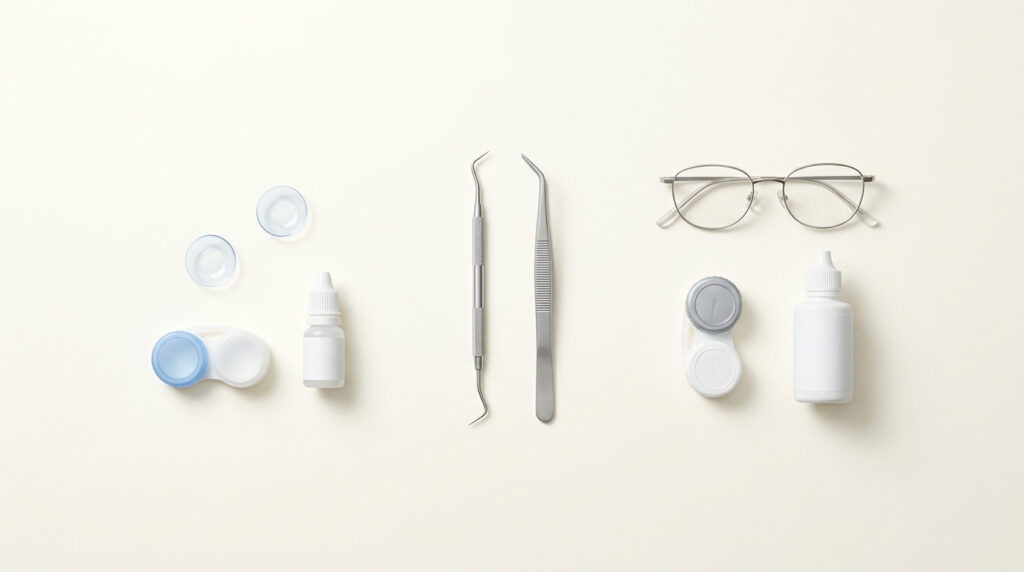
Which Option Is Right for You?
Contact lenses have the lowest upfront cost and the highest flexibility, but require daily management. The practical choice when myopia is still progressing or surgical conditions aren’t met.
LASIK / LASEK / SMILE carry a higher initial cost but offer permanent correction in a single procedure — the clearest option for adults who meet the corneal and prescription requirements.
Ortho-K enables glasses-free daytime vision without surgery and actively slows myopia progression, making it especially valuable for growing children. The trade-off is that the effect is not permanent and daily maintenance is required.
Whichever path you choose, a thorough consultation and examination with an ophthalmologist is the most important first step. Corneal thickness, prescription level, and lifestyle all play a significant role — the same method can produce very different outcomes depending on the individual.
나에게 맞는 방법은?
세 가지 방법을 한눈에 비교하면 이렇다.
콘택트렌즈는 초기 비용이 가장 낮고 유연성이 높지만 매일 관리가 필요하다. 근시가 진행 중이거나 수술 조건이 안 되는 경우의 현실적 선택이다.
라식·라섹·스마일라식은 초기 비용이 높지만 한 번으로 끝나는 영구 교정이 최대 강점이다. 각막 두께와 근시 도수가 조건을 충족하는 성인에게 가장 확실한 선택지다.
드림렌즈는 수술 없이 낮 시간 맨눈 생활이 가능하고 근시 진행 억제 효과가 있어 성장기 어린이에게 특히 유효하다. 단 영구적 효과가 없고 관리 부담이 따른다.
어떤 방법이든, 시작 전 안과 전문의의 정밀 검사와 상담이 가장 중요하다. 각막 두께, 근시 도수, 생활 패턴에 따라 같은 방법도 결과가 완전히 달라질 수 있다.
